মঙ্গলবার, ১৬ জুন, ২০২৬

How to Get Admission to Argentine Universities from Bangladesh: A Step-by-Step Guide


Argentina has become one of the most attractive study destinations for Bangladeshi students seeking quality higher education at a low cost. Public universities in Argentina offer highly respected degrees, and many programs have little or no tuition fees compared to universities in North America, Europe, or Australia. In addition, Argentina provides a rich cultural environment, modern cities, and opportunities to learn Spanish while pursuing academic goals.

If you are a Bangladeshi student planning to study in Argentina, follow these essential steps.

1. Choose Your Program and University

The first step is deciding what you want to study. Argentina offers a wide range of programs, including:

  • Medicine
  • Engineering
  • Business Administration
  • Economics
  • Arts and Humanities
  • Social Sciences
  • Agriculture
  • Architecture

Some of the most popular universities include:

  • University of Buenos Aires (UBA)
  • National University of La Plata
  • National University of Córdoba
  • National University of Rosario

Research the admission requirements, language of instruction, and application deadlines before making your final choice.

2. Verify Academic Requirements

For undergraduate admission, students usually need:

  • Higher Secondary Certificate (HSC) or equivalent
  • Academic transcripts
  • HSC transcripts must be officially validated in Argentina
  • Passport copy
  • Passport-size photographs

For postgraduate programs, universities generally require:

  • Bachelor's degree
  • Academic transcripts
  • Curriculum Vitae (CV)
  • Statement of Purpose (SOP)
  • Recommendation letters (for some programs)

Ensure that your academic qualifications meet the university's minimum requirements.

3. Legalize and Translate Your Documents and Validate

This is one of the most important steps.

Argentine universities usually require foreign documents to be:

  • Notarized
  • Authenticated by the relevant authorities in Bangladesh
  • Legalized or apostilled according to current regulations
  • Officially translated into Spanish by a certified translator when required
  • Officially validated in Argentina

Common documents needing translation include:

  • Certificates
  • Mark sheets
  • Birth certificate
  • Police clearance certificate

Prepare multiple copies because various institutions may request them during the admission and visa process.

4. Learn Spanish

Most undergraduate programs in Argentina are taught in Spanish.

Therefore, students should:

  • Start learning Spanish as early as possible
  • Aim for at least A2–B1 level before arrival
  • Continue language training after reaching Argentina

Many universities offer preparatory Spanish courses for international students. A strong command of Spanish significantly improves academic success and daily life.

5. Submit the University Application

Once your documents are ready, submit your application according to the university's procedure.

Important tips:

  • Check application deadlines carefully.
  • Submit complete documentation.
  • Keep digital and printed copies of everything.
  • Monitor your email regularly for university communications.

Some universities accept online applications, while others may require additional verification after arrival.

6. Receive the Admission Letter

If your application is successful, the university will issue:

  • Admission letter
  • Acceptance certificate
  • Enrollment instructions

These documents are essential for your student visa application.

Carefully review any additional requirements mentioned by the university.

7. Apply for a Student Visa

After receiving admission confirmation, apply for an Argentine student visa.

Typical requirements include:

  • Valid passport
  • University admission letter
  • Proof of financial support
  • Medical documents (if required)
  • Police clearance certificate
  • Visa application forms
  • Passport photographs

Apply well in advance because visa processing can take several weeks.

8. Arrange Accommodation and Finances

Before travelling, estimate your living expenses.

Major costs include:

  • Housing
  • Food
  • Transportation
  • Health insurance
  • Study materials

Many students initially choose:

  • University residences
  • Shared apartments
  • Student hostels

Having sufficient financial planning will help you settle comfortably.

9. Travel to Argentina and Complete Enrollment

Upon arrival, you may need to:

  • Present original documents
  • Complete final registration
  • Obtain a student identification card
  • Register your local address
  • Open a bank account if necessary

Attend orientation sessions to learn about campus facilities and academic procedures.

10. Apply for Residence Documentation

International students generally need to complete immigration procedures after arriving in Argentina.

This may include:

  • Temporary residence registration
  • Local identification documentation
  • Updating personal information with immigration authorities

Always follow the latest immigration guidelines and university instructions.

Most important: 1. Argentina universities require Minimum Spanish Language level B1 for undergraduate admission. 

                           2. After Validation of academic transcripts in Argentina, the student must present valid B1 pass certificate to apply for University sponsorship. The University will do the electronic filling of the student data in the National Directorate of Migration. This is called admission enrollment document (Constancia de Inscripción Electrónica). Then the University will apply for Obtaining an Argentina Student Permit from Immigration (Migracion de Argentina).

11. Conclusion:

    Studying in Argentina can be an excellent opportunity for Bangladeshi students seeking affordable, high-quality education and international exposure. The key to success is early preparation, proper document legalization, Spanish language learning, and careful compliance with university and visa requirements. By following these steps systematically, Bangladeshi students can smoothly transition from their home country to one of Latin America's leading educational destinations and build a strong academic and professional future.

বুধবার, ১৭ জুন, ২০২০

Spectacular Iquique

Introduction: Iquique is the capital of the region of Tarapacá and one of the most visited cities in the north of Chile. Iquique, famous for the exploitation of saltpeter Iquique (salitre) surrounding is a

beautiful coastal city in northern Chile, to the west of the Atacama Desert. It's a popular holiday destination with a tax-free port area, shinning beaches and a seafront casino. Iquique is  called the 'meeting point'. This is a city where birds and sea-lions sleep together. In its historic district, an iconic 19th-century clock tower stands in Arturo Prat Square, the city's main plaza. 

Why tourist meeting point: Iquique is often called the meeting point because this city is connected to Bolivia, Peru and the south of Chile. During summer, tourists arrive in Iquique from many parts of the world. They visit, they relax and explore the grand surroundings. 

                                                 Important tourist points in Iquique: 

Corvette Esmeralda museum: Museo Corbeta Esmeralda:
The Corbeta Esmeralda Museum is a Chilean museum located in the city of Iquique (Tarapacá Region). In fact this is a replica of full-scale representation of the Chilean corvette Esmeralda, sunk in the Iquique naval combat that occurred in 1879. Esmeralda was opened as a museum ship on 20 May 2011 by President Sebastián Piñera, including the descendants of Arturo Prat.

Plaza Arturo Prat:
The main square of the city of Iquique or just Plaza Arturo Prat is the main square in Iquique city. This square constitutes a heritage area with several buildings classified as historical monuments : The Clock Tower, the Tarapacá Employees Protective Society Building and the Municipal Theater, which together are one of the most representative urban expressions of the saltpeter period along with the Spanish Casino and the Croatian Club.

Cavancha sea beach:
Cavancha Beach is located in downtown Iquique and it has good conditions to practice outdoor and sport activities, like surf and swimming. It´s the largest beach in the city surrounded by a modern
urban architecture, the seashore and a walking area. Cavancha is the most attractive tourist point in Tarapaca region. During summer, millions of tourists both from Chile and overseas visit this amazing beach. There are various sporting activities for all classes of people. The most beautiful and eye-catching activity is with the children who play with sand and water. They remain extremely busy digging holes and carrying water and building sandy architectures by the beach. Though somewhat boring, the endless shouting of vendors is definitely a memorable experience of Cavancha tour.  

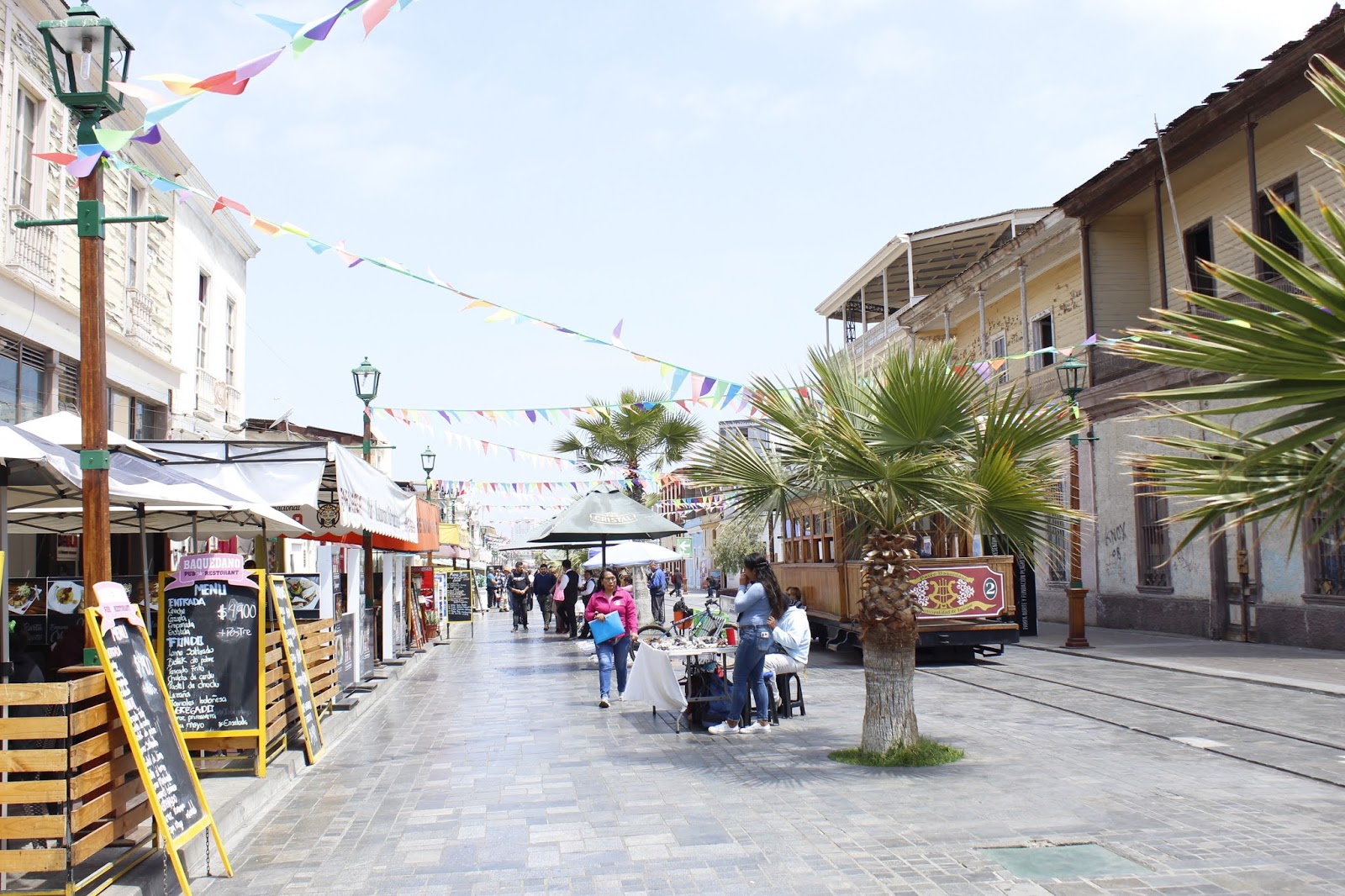
Baquedano street: 
Baquedano Street is a long avenue in the old quarter of Iquique, Chile. It is a popular tourists attraction and is a “typical zone,” a status that preserves its historical and architectural heritage. It is characterized by its late 19th- and early 20th-century houses built of wood from Europe. The
architecture that Baquedano Street exemplifies accommodates Iquique's prevailing climatic conditions. The buildings on Baquedano Street and, in general, all those that follow the city's traditional architecture, were built as stores or houses by immigrants who amassed fortunes through the nitrate works. The buildings typically show a continuous frontage and a verticality and lightness. They are typically organized around a central nucleus and feature vestibules, verandahs, skylights or lanterns, watchtowers, and a serial or "shady" roof over the terrace roof.

Paseo Peatonal Cavancha:
This is a footpath located along Cavancha beach. This is stretched from north to south and is made of timbers. In the evening, thousands of visitors walk along this wooden path and enjoy the beautiful sunset.   

Paseo lancha de Muelle Prat:
The boats located on the Arturo Prat dock offer a different, educational and fun panorama. One of the attractions of the trip to the Esmeralda buoy are the stories that the boatmen themselves tell their passengers about the history of naval heroes, details of the Pacific War and unimaginable curiosities of the animals that accompany the routes to get closer every day. 

Boya Esmeralda de Iquique: Emerald Buoy:
It is located in the northern sector of the waterfront, near the Iquique parade ground. The buoy marks the place where the remains of the Emerald sunk during the Naval Combat of Iquique, on May 21, 1879 are located. Tourists can approach it in boats. Every May 21 the authorities come to pay tribute to the naval heroes.

Casino de Cavancha: 
Casino Dreams Iquique is an important contribution to the world of Tourism and entertainment with a wide comprehensive offer under the concept of rest and fun. It is located a few steps from Cavancha beach, a place where entertainment and fun never perish. With the highest technology and a state-of-the-art structure, it has 573 modern gaming machines and 29 game tables. It has two environments: smoking and non-smoking. Live music goes on weekends.

Brava sea beach:
Brava beach is located 4 kms. from the center of Iquique. It is located in the southern sector of the city, between Huayquique beach and Cavancha beach.
This beach occupies a large part of the urban coastal edge of Iquique and is not suitable for swimming since it has strong waves.  Usually, paragliders descend into the arena of Brava beach. 

Fishing boats of Iquique:
Colorful fishing boats add a new beauty to Iquique tourism. Very early morning, many boats leave the coast to collect fishes and return before evening. Some boats return after a couple of days. These boats are seen in Iquique port area and around Cavancha.  

Sea lions (Lobos marinos):
Sea-lions are the most amazing natural spectacle of Iquique city. Sea-lions (lobos marinos) are found sleeping, playing, eating and roaring in coasts near Iquique port and Caleta Riquelme. They are also found relaxing at Isla de lobos (Sea lions' island) in Iquique port. They are the vital part of tourism. Though it is prohibited to offer
food to sea lions, fishermen generally throw fish waste to them. As soon as the fish waste is thrown, the sea lions engage in terrible fight among themselves. Sometimes, sea birds like albatross, pelicans and sea gulls take part in the fight to grab the fish waste.  

Pelicans of Pecific:
Giant pelicans are seen gathering around in Iquique coast. Tourists throw the fish waste to pelicans just to see the amazing fight for food. Apart from pelicans, there are various sea birds like albatross, sea gulls, etc. Very often pelicans snatch or steal fishes from inattentive fishermen.


Ferocarril Iquique: 
The Tarapacá Saltpeter Railroad Station is an industrial building that was built during the second half of the 19th century, prior to the War of 1879 or the Pacific War. Its construction is part of an investment project promoted by the Peruvian government that sought to modernize the mineral and passenger transport system. By decree, in 1860, Messrs. Federico Pezet and José M. Costa were given the task of building a railway route between the city of Iquique and the mining towns scattered throughout the desert. However, the failure of the deadlines agreed in the decree by both entrepreneurs, resulted in a new decree that handed over the engineering task to Don Ramón Montero y Hermanos; who inaugurated the work and saw the first train leave on July 28, 1871.

Charles Darwin's monument: 
The monument to Charles Darwin in Iquique is located in front of the former Customs building, also known as Rímac Palace, between Aníbal Pinto streets, Jorge Barrera and Arturo Prat Chacón avenue. It consists of a bright black painted iron anchor on a white cement base. Two bronze plates are embedded in the cement plinth, one has the bust of the English naturalist engraved next to a brief review of his work and the figure of the brig Beagle, and the other a fragment of the grapes and the wind of Neruda where reference to Darwin's passage through Chile. He embarked on the second expedition of the Beagle brig along the South American coasts, between 1831 and 1836, under the command of Robert Fitz-Roy. After crossing the Atlantic and crossing the coasts of Brazil, Uruguay and Argentina, the expedition crossed the Strait of Magellan and disembarked at the port of Valparaíso in 1834.

Regional museum of Iquique:
Iquique's former court house now hosts the catch-all regional museum, which earnestly re-creates a traditional adobe altiplano village and also exhibits masked Chinchorro mummies and elongated skulls. Photographs placed inside the museum explore Iquique's urban beginnings, and a fascinating display redirects the attention to the nitrate industry.

Military museum of Iquique:
Located in Baquedano 1396, Iquique. The house that occupies the Tarapacá Military Museum of the VI Army Division, corresponds to a building of ancient historical data in the city of Iquique. The museum houses a collection of about 500 pieces, mainly metal, weapons and ammunition, also paper and textile. Some of the most prominent pieces are: Carbine Winchester Model 1866, Blakely Rifle, and a burlap inscribed with the name of the soldier Sebastián Figueroa, a textile formerly used as a parcel wrap. The collection houses objects from the 1991 Civil War and the Pacific War.

Caleta Riquelme:
Caleta Riquelme is a coastal fish market near Iquique port. There exist many temporary and permanent fish selling shops. Fresh fishes and other sea stuffs are sold there from morning to
afternoon. Additionally, all sea related religious festivals are celebrated there. Ceviche (a Chilean typical food) is generally produced and sold  in this area. 

Hindu Temple (Templo Hindu de Iquique):
Hindu Temple is located at Rancagua street in Iquique city. This temple plays a vital role to celebrate Indian national days. Almost all Hindu festivals are celebrated here. Most important festivals are
Janmastami, Holi, Durga puja, Diwali, etc. 

Mosque (Mezquita Bilal de Iquique):
Centro Islamico (Islamic center) Mezquita Bilal is located at Av. Pedro Prado corner, El Aguila Iquique 3291, Chile. This is only mosque in Iquique city. All Islamic celebrations and festivals are celebrated here.  

Mall Zofri: 
Zofri is a mega mall located at the northern part of Iquique city. A beautiful location with Pacific coast at one side and the Andes on the other side, Mall Zofri has huge business enterprises. Most of the companies and enterprises are foreign owned. This is a tax-free zone area. Hundreds of exporters regularly export merchandises from all over the countries. Though it is a business  point, tourists tour the mall as a part of an amazing tourist place. 

Parachute riding:
The wild Chilean geography, full of hills and high mountains is the perfect setting for skydiving and all sorts of aerial sports. There are many parachute riding schools in Iquique. During summer, hundreds of flyers fly colorful parachutes. They jump from Alto Hospicio, the high city and land on cavancha and Brava sea beaches.  

Surfing and water sports: 
Iquique is one of the most popular northern cities for surfing and paragliding. This city is well-known to have excellent waves for surfing and bodyboarding. During
the summer months, the beach gets crowded for visitors and water sporters. It is said that Iquique has world-class waves for bodyboarders and surfers. 

Carnavals of Iquique: 
Andean Week, held in Iquique in the second week of February, has two key events: a carnival and a smaller, lesser-known side event. During carnavals, an exposition and gathering of the different faces of Andean culture, and show of traditional foods are eye-catching spectacle. In the year 2019, around 7,000 people attended the event, which is organized by the Chilean government’s National Corporation for Indigenous Development (CONADI).
The carnival takes place in Iquique’s Parque Balmaceda, and the side event is held in the former Cavancha stadium.

Monument of Arturo Prat: 
This bronze sculpture of Arturo Prat Chacón on cement is located in the center of Plaza 21 de Mayo, in front of the English School in Iquique at the end of Baquedano street. The monument represents the figure of Arturo Prat Chacón, facing the sea, wielding his sword with his right hand while holding the Chilean flag with his left. Six other plates, installed on different dates, complement the sculpture. In one of them the confrontation at sea of ​​the Chilean corvette Esmeralda and the Peruvian monitor Huáscar is represented; in another, the figures of the Iquique martyrs appear: Midshipman Ernesto Riquelme and 2nd Lieutenant Ignacio Serrano. The set commemorates the naval combat of May 21, 1879, in the framework of the Pacific War (1879-1883), also called the saltpeter war because economic interests in this mineral were one of the main causes of the conflict. Apparantly, this monument is of high importance from historical perspective. Besides, there are many historical monuments around the city that are frequently visited by historians and researchers. 

Plaza Condell: 
The Condell plaza is built on 4 floors, which include two with 308 parking spaces, a food court and the urban plaza, with an extension of more than 10,000 square meters. This plaza is surrounded by Ripley market and other buildings. All day long tourists gather around this plaza.  

Slava Square of Iquique:
A monument consisting of a tall column with symbolic decorations is erected. The coats of arms of Chile and the Kingdom of Croatia, Dalmatia and Slavonia are sculpted on it with the legend “Homage of the Slava Colony of Tarapacá to the First Centenary of the Independence of Chile” 1810-1910. The monument was built in 1912 by Andrés Rožmanić Suzanić, born in Chile to Croatian parents who had emigrated from Mali Lošinj.
This square unfairly and arbitrarily disappeared from the Balmaceda Park in 1965, its monument was demolished and only the bronze plaque at the base of its tower - which was recovered from the municipal pens in 1987 - was preserved.
The Croatian colony of Iquique decided to rebuild the square, being reopened in 2010. During the reconstruction of the square, everything was done exactly as before. The coat of arms and the old copper plate were put with the text: The Slavic colony of Tarapacá - on the occasion of the first century of the independence of Chile.
Ducks used to come to the fountain in the square. Now there are no more, but duck sculptures have been put in place to restore the old atmosphere, as many generations of Iquiqueños preserve in their memory.

Galería turística artesanal Baquedano:

Baquedano Artisan Tourist Gallery has been there since infinite times. And it has become a must-see for those who walk along the promenade of the same name.
Fifteen stores open their doors daily from 9 in the morning until after midnight. Apart from these 15 stores, there are other two tourist markets near central plaza. In the stores, there are local made handicrafts. Most of the handicrafts mark the work 'Iquique'. The stores sell typical dresses, local foods, tapestries, walmats, dolls, showpieces, etc. They also sell Chilean musical instruments, bags and colorful cloths. 

Communication: 
Near to tax-free zone and the port of Iquique, there is the Bus Terminal of this city, a boarding point for transportation companies such as Andes Mar Chile, Pullman Bus, Expreso Norte, Turbus, Condor Bus. This terminal is characterized by offering its information in Spanish and in Aymara, language of the indigenous people of Los Andes. The most frequent national destinations of this terminal are: Santiago, Calama, Arica and Antofagasta. The international destination is Tacna of Peru and Oruro and Cochabamba of Bolivia. 
Diego Aracena International Airport (Aeropuerto Internacional Diego Aracena IQQ) is an airport serving Iquique, capital of the Tarapacá Region in Chile. The airport is on the Pacific coast 48 kilometres south of the city. It shares a runway with Los Cóndores Air Base, home to the First Air Brigade of the Chilean Air Force. 

Conclusion: 
Iquique is such a Chilean city that always wait with all her richness and grandeur to receive tourists all the year round with the sign ' Bienvenido'. 

References:
https://www.welcomechile.com/iquique/saltpeter-facilities.html
https://www.myguidechile.com/things-to-do/iquique
https://www.monumentos.gob.cl/monumentos/monumentos-publicos/arturo-prat
https://www.monumentos.gob.cl/monumentos/monumentos-publicos/plaza-slava
https://herenciacroata.wordpress.com/2016/09/20/plaza-slava-de-iquique/
https://www.tripadvisor.com/Tourism-g297397-Iquique_Tarapaca_Region-Vacations.html

বুধবার, ৬ মে, ২০২০

How to apply for Bolivian tourist visa?


Planning for a trip to a far-away country in Latin America? Looking for an easy visa policy? If yes, then Bolivia should be your chosen destination. There exists a simple, flexible, easy but rich life style. But how to get into Bolivian territory? 

Recently there are various scams regarding Bolivian visas that Bolivia offers electronic visas and visas are obtainable on arrival for Bangladeshi and Indians. Practically, Bolivian immigration are reluctant to issue visas on arrival at airports. And the wiser policy is to get a consular visa from Bolivia embassy. There are Bolivia embassies and consulates around the world. 

Let me focus on the procedure of getting tourist visa for Indians and Bangladeshis. For both nationals, visa applications have to be made at Bolivia Embassy in New Delhi. There is no exception. 

Step 1: Every Visa applicant requires to collect the following documents: 

1. Passport (valid for at least six months)
2. Photo (high quality recent photo showing 80% of face with white background)
3. Yellow fever vaccine certificate
4. Notarized, legalized (from Bolivian Foreign Ministry) invitation letter from Bolivia OR, Confirmed hotel reservation (for entire duration of trip) from Bolivia
5. Tour plan from a registered tour operator (day to day)
6. Bank statements, sealed and stamped from bank (at least three months)
7. Income Tax return ITR , at least one year (if any)
8. Air ticket reservation (to and fro)
9. Cover letter (to be addressed to Consular officer) detailing your motive to travel Bolivia
10. Professional documents 
11. Police certificate (recent) for Bangladeshi citizens

Step 2: When all documents are collected, applicant has to scan them and save in PDF file separately. Never take photos of documents by mobile phones for visa purpose. 

Step 3: Sign up for an e-mail account. Now, open the Bolivia visa application online with the following link: 


There is language option for English and Spanish version. Choose the English version and follow up. Insert all asked data in the application system. Never and never enter any false information because if you are found with any fake information or document, you may be blocked for several months, even for many years. When all pages are done, you may see the preview of the application form. 

If you are sure that your application is authentically filled-in, click the 'Finish' button. 

Instantly, your computer will display a color visa form (Sworn declaration form) having 2 pages. Make sure that there is your photograph and a number. The form without the number is invalid. 

Now, you have applied for a tourist visa. Print the form in color, sign below at the designated place. 

Carefully read the printed form and below you will find that this form is valid for 15 days only from the date of application. That means, you must go to the embassy with the form along with all original documents that you have uploaded within 15 days. 

Step 4: Get prepared for the interview. Be very simple and authentic and sincere during your interview with the consular. Be 100% honest with every question. If you are in doubt, simply request a repeat. Never make argument with the officer. Never try to influence or threaten the visa officer in any way. Respect the official decorum. Remember, Bolivian officers always carry smile while talking with others. 
Normally, visas are approved within two working days. Bolivia tourist visas are free of cost for Bangladeshi and Indian citizens. 

While receiving your passport with visa, don't forget to say 'Thank you Sir / Madam'. 

Article written by:
Amar Chand Nath
Iquique, Chile.


শনিবার, ২৫ এপ্রিল, ২০২০

History of Ferrocarril, Iquique, Chile

 History of Ferrocarril, Iquique, Chile


Located in Sotomayor street with Vivar, its construction dates from 1871, and is characterized by its original architectural style. It includes the Administration and Platform building. It was inaugurated on July 28, 1871, it was the Central station of the nitrate railway from Iquique to La Noria. This railway was built shortly before the Pacific War in territories that were still Peruvian in those days.  Its builders, Ramón Montero and Hermanos, obtained from the state of Peru, on July 11, 1868, a concession to build a railway from Iquique to the nitrate field of La Noria. 

Then, on May 18, 1869, they were authorized to build a line from Pisagua to Negreiros and finally on October 26, 1871, they were granted the concession to build a road that would connect the two previous ones.

 In 1873, the railroad, built with Stephenson's standard gauge (1,435), was transferred to the National Saltpeter Railways of Peru, which later became The Nitrate Railways Company Limited. In 1887, after the War of the Pacific, all these territories were under Chilean sovereignty. Faced with the uncertainty that Chile would recognize the terms of the concession granted by Peru to the Monteros, they sold the majority of the railroad shares to John Thomas North at a much lower price than the real one. In 1890, Mr. North built a new branch to the south, reaching Pintados and Lagunas.

Among the main difficulties that the Monteros had to face during their construction, was the difficult ascent from sea level to a height close to 1000 meters in just a few tens of kilometers.

 In the section from Iquique to La Noria, there was a section of approximately 18 kms. with a steep slope of 4%, so it was necessary to buy Double Fairlie-type locomotives in England, thanks to which it was possible to drag 150-ton trains on the aforementioned slope.

In 1926 three articulated locomotives of the Beyer-Garratt type were commissioned, which were assigned to the Iquique - Las Carpas section. Then, in 1928, two more were acquired, even though by then the nitrate industry was already beginning to decline.

 Impressive Beyer Garratt-type locomotive:

Its strategic location in the area quickly turned the "Nitrate Railway" into a monopoly company, obtaining very important profits for many years. 

Precisely to break this monopoly, the State of Chile authorized in 1914 the construction of a fiscal railway with a 1-meter gauge, between Pintados and Iquique, which could only start operations 14 years later, in 1928.

The Nitrate Railway had been born from several concessions of different dates, which gradually expired from 1936, beginning with that of Iquique to La Noria. For some years the company continued operating on the road and paying a toll to the State, although around 1950 it ceased to have an interest in its exploitation, for which reason it sold the lines and equipment to the State Railways, which formally received them in September from 1951.

                                                                            
Steam railcar of the type existing on this railway:

The State was in charge of maintaining the services to the nitrate offices that were still in operation: Prosperidad, Humberstone, Peña Chica, Mapocho, Victoria, Santa Rosa, Keryma, San Enrique, Iris and Alianza. Since the State took over the road, the section from Pintados to Iquique was converted to the metric gauge, leaving the "fiscal" route and directing the trains through the route of the old Salitrero Railway. 

Once the gauge was changed, most of the Stephenson gauge gauge rolling stock was dismantled, including a beautiful steam railcar.

শনিবার, ২৮ সেপ্টেম্বর, ২০১৯

Charles Darwin's Memorial in Iquique, Chile


In 1831, the English naturalist Charles Darwin embarked on a trip aboard the British ship Beagle, which It would last five years. During the crossing, Darwin had to collect and study specimens of plants and animals, to prepare a report of their observations.

During the trip, Darwin devoted himself to studying the nature of the South American coast and noted evidence of certain changes happened in the earth's crust, as failures, folding and erosion. Darwin also conducted excavations, where he could find fossils of large mammals.

The monument to Charles Darwin in Iquique is located in front of the former Customs building, also known as Rímac Palace, between Aníbal Pinto streets, Jorge Barrera and Arturo Prat Chacón avenue. It consists of a bright black painted iron anchor on a white cement base. Two bronze plates are embedded in the cement plinth, one has the bust of the English naturalist engraved next to a brief review of his work and the figure of the brig Beagle, and the other a fragment of the grapes and the wind of Neruda where reference to Darwin's passage through Chile. Charles Robert Darwin was born in Shrewsbury, England, in 1809. He entered to study medicine at the University of Edinburgh with only 16 years, but his true passion was geology and natural sciences, which he studied in Cambridge. He embarked on the second expedition of the Beagle brig along the South American coasts, between 1831 and 1836, under the command of Robert Fitz-Roy. After crossing the Atlantic and crossing the coasts of Brazil, Uruguay and Argentina, the expedition crossed the Strait of Magellan and disembarked at the port of Valparaíso in 1834.

Darwin and the other scientists toured the central valleys, Chiloé and the archipelagos of Guaitecas and Chonos, in southern Chile. On July 12, 1835, the Beagle boat docked at the port of Iquique, this being the particular landmark that commemorates the monument. As a result of this journey of exploration and research in different fields of science, Charles Darwin wrote Journey of a Naturalist Around the World, published in 1839. The observations made in this expedition were the basis on which Darwin developed his theory of the evolution of the species, which was severely attacked by the Catholic Church because it contravened creationism. The Copernican turn that brought the Darwinist theory of evolution in the scientific world was remarkable. 

During the twentieth century some biologists have refuted or complemented Darwin's theory, such as the American Lynn Margulis, who argues from the symbiogenesis that biological diversity is not produced by competition as much as by collaboration.

Source:  https://www.monumentos.gob.cl/monumentos/monumentos-publicos/charles-darwin

রবিবার, ৮ জুলাই, ২০১৮

Chilean Reformed Immigration Regulation: 2018


On Monday April 9, 2018, His Excellency President Sebastián Piñera announced the reformed immigration Law in Santiago. President Piñera declared that Chile will be a country which will welcome immigrants with open arms. Piñera said that due to the large number of immigrants entering the country recently, Chile needs an immigration reform. At the moment Chile counts over 1 million immigrants, of which an estimated 300,000 are illegal. Therefore, right now it is necessary to establish laws that will guarantee the immigration process which will be safe, regulated, organised. The law will confirm a transparent, humanitarian and decent treatment for both immigrants and Chilean citizens whose interests shall also be considered.

The reformed law is a milestone in the history of Chile as it is committed to protect Chilean immigration sector. 

What are the Objectives of the New Immigration Reform in Chile?

The government has set the following objectives for the new immigration reform:

President Piñera has announced the new immigration reform.

1. To guarantee law binding  immigrants a righteous and human treatment.

2. To prevent the entrance of immigrants with a criminal record into the country and strengthen efforts to  against human trafficking.

3. To create a Migration Policy Council in order to create and systematically update, on a regular basis, a migration policy that is clear and transparent. Furthermore, this includes the creation of a National Migration Service, which will be in charge of the executive part of this policy.

4. To create a flexible system of migration categories. This will eliminate the possibility of changing a tourist visa into a residence permit while in Chile. This has been done by many immigrants until now, however, this made it difficult for the government to have a good and clear overview regarding the number and status of immigrants in the country. Therefore, applying for a residence permit from now on has to be done in the country of origin of the applicant.

5. The right to access healthcare.

6. The right to access education.

7. The right to access social security and other fiscal benefits for those that have been residing legally in the country for at least 2 years.

8. Modernisation of the validation process of foreign academic titles.

9. National foreigner registration.

10. Changes in obtaining temporary residence process.

11. Decriminalisation of illegal stay.
Simplifying the deportation of individuals who have violated the migration law during their stay. Immediate deportation of individuals who try to enter the country under unlawful conditions.

What Are the Administrative Changes to Chile’s Immigration Laws?

Reformulation of temporary residence visas created by administrative means:

a. Elimination of the possibility to apply for a temporary visa for working purposes starting from on April 23, 2018. 

b. Temporary opportunity visa: This visa should be requested outside of Chile. The visa is granted for 12 months and can be extended once. This visa is for all individuals who stay in Chile for working purposes up to 12 months. It means Visa Sujeta a Contrato (work visa) has to be applied in the country of origin of the applicant. This visa will come into force on August 1, 2018.

c. Temporary international orientation visa: This visa should be requested outside of Chile. The visa is granted for 12 months and can be extended only once. This visa is for all individuals that come to Chile for working purposes and have a Master’s degree from a world renowned university. A list of these specific universities will be established in the law. This visa will come into force on August 1, 2018.

d. Temporary national orientation visa: This visa is requested in Chilean territory. The visa is granted for 12 months and can be extended once. The visa is granted to individuals who come to Chile for working purposes and have a Master’s degree from a Chilean university. This visa will come into force on August 1, 2018.

Haiti Issue:

From April 16, 2018 on, Haitians will need a Visa Consular de Turista Simples that will allow them to stay in Chile for 30 days. This visa does not apply to those who come for working or migration purposes. It means Visa Sujeta a Contrato (work visa) has to be applied in the country of origin of the applicant (Haiti).

Furthermore, there will also be established a Visa Humanitaria de Reunificación Familiar. This visa is intended for the reunification of families. The visa is granted for 12 months and can be extended once. However, a maximum of 10 thousand of these visas can be granted and it should be requested at the Chilean embassy in Haiti.

Venezuela Issue:

Due to the current political crisis in Venezuela, the “Visa de Responsabilidad Demócratica” will enable Venezuelan citizens without criminal records to seek refuge in Chile. This visa should be requested at the Chilean embassy in Caracas and allows a temporary residence stay of 1 year, which can be extended only once. This visa will come into force on April 16, 2018.

The Chilean government has enabled Venezuelans to do a part of the application process online in an effort to avoid never ending queues outside of the Chilean Consulate in Caracas. After filling in all the necessary information and documents online,  an appointment is arranged at the embassy to obtain the pertinent stamps and seals.

What Is the New Regularisation Procedure for Immigrants in Chile?

One of the main reasons for this reform is to control the immigration of illegal immigrants into Chile. In order to do this, the government will start a regularisation procedure for those who are in the country under illegal circumstances.

It will permit foreigners who are currently in Chile under illegal conditions, who arrived in Chile before April 8, 2018, to register and regularise before the authorities.

Individuals who entered the country under illegal circumstances need to register and apply for a temporary residence permit within 30 days starting on April 23, 2018.

Individuals who are staying in Chile with a residence permit or tourist visa that has expired will need to register and apply for a temporary residence permit within 90 days, starting on April 23, 2018.

Individuals who are working without a working permit, individuals that, as of April 8, 2018, have a valid tourist visa, individuals that have a visa submission in process and individuals that have a reconsideration in process, will have to register and apply for a residence permit within 90 days, starting on April 23, 2018.

The following individuals will not be granted a permit: Those that are deemed a threat to national and international safety. Those that are involved in illegal trafficking of drugs, weapons, contraband or people. Also those that have previously been expelled from Chile for reasons that are still currently in valid.

Furthermore, a permit will not be granted to those that have previous convictions or are under investigation for acts that are considered crimes by the Chilean law.

The Chilean authorities will determine the validity of the documents that are presented by the applicant. Based on this, the Chilean authorities can approve or reject the application.

Those that are currently residing under illegal conditions and who do not register before the deadline will be expelled from the country. Those that present invalid documents will also be expelled.

This is the translated material from Spanish original. Please check Immigration Department, Ministry of Foreign Affairs, Republic of Chile for more and updated information. 
.........................................................................
Source: 1. http://santiagotimes.cl/2018/04/10/migrating-to-chile-get-tougher-for-haitians-and-venezuelans/

2. https://cdn.digital.gob.cl/filer_public/b0/09/b0099d94-2ac5-44b9-9421-5f8f37cf4fc5/nueva_ley_de_migracion.pdf

3. https://www.bizlatinhub.com/migration-reform-chile/?cn-reloaded=1

মঙ্গলবার, ২৪ এপ্রিল, ২০১৮

Chilean Job opportunities for Foreigners.


Moving to Chile for settlement? Interested to get a suitable job? If yes, you have taken an excellent decision to build up a shining future in the richest country in Latin world. 

But Chilean work visa is a complex one for those who have little knowledge on Chilean immigration and labour law. 

It is always wise to 'look before you leap' before boarding a flight to Chile. You may bear the risk of returning for updating your professional diplomas to grab a job in Chile.

What is a Chilean Work Visa?

Work in Chile is very disciplined. Neither the employee nor the employer can bother each other in any way because the labour law is very strict here. In every city there exists the Ministry of Labour where it is free to lodge a complain file. The inspectors check the complains and personally visit the work place to investigate into the lodged complain. If any irregularity is found, he imposes penalty. 

The work visa of Chile should be caterorized into two types. First: The visa that can be obtained after coming to Chile with any other visa (tourist, business, student, etc.) Second: The visa that can be obtained before coming into Chile. This type of visa is a residence visa.

The former visa is a residence visa or residence permit. The processing steps are:

1. Make a work contract at a local notary office with an employer in Chile. The employer may be a person or a company owner. One can employ a foreigner for his personal household work also.

2. Collect documents like passport copy with Chilean existing visa, entry receipt, photos, etc. Note that while applying for residence visa, you must live in Chile legally. If you are living illegally or your visa is expired, you should contact intendencia office. They will check the visa and will fix up a fine payable to a local bank. 

3. Fill up the residence permit application form. Available at Immigration website. 

4. Go to immigration locally called migracion office. The officer will check the documents and receive the papers. They will upload the application into their visa system. After uploading you may check the visa status yourself by entering your vital data into consultation page online. Click Visa consultation page

The latter is a quite different process. In this case, you need to search a job in Chile. You may search online or by anyone who is living in Chile. Note that there are plenty of jobs but not all of them are published online. Only the big ones are found in the internet. The best way is to make the search by your relative in Chile. 

When you find a suitable job, you should employ a local lawyer who will prepare the work contract. You need to send your passport copy because the contract will be prepared using your passport details. The prospective employer will sign but your signing place will remain empty. Then this incomplete contract should be sent to you in original by courier. After receiving this, you are required to go to any Chilean consulate to get it signed and legalised by the related officer. After the signing and legalization you may apply for a work visa at the same consulate. (The link is about the student visa information but also about the visa application process.) Click here Visa Application system

What jobs are available in Chile?

The available jobs should be classified into two groups. The professional or skilled work and the unskilled work. The professional jobs belong to advocate, doctor, IT specialist, trainer, marketing personal, nurse, engineer, architect, English teacher, tourist guide, travel related professional etc. Know how to validate or revalidate your professional diplomas and certificates. Click for info Revalidate foreign diplomas

Unskilled works belong to salesman, hotel work, cook, carpenter, painter, electrician, helper, driver, domestic worker, cleaner, security personal etc. 

Chile is famous for Grape and apple plantation. There are lots of available works. Additionally, Chile has copper mines that require lot of workers. Note that there exist many related institutes that train the unskilled workers. Many odd jobs are available in the sea ports. 

What about salary? 

Chile practises a regulation about the minimum wage. Nobody can pay below the range. Right now this lowest wage or salary is 276,000 Chilean pesos ($409) effective Jan. 1, 2018. Check you updated information. Click here Ministry of Labour

The employer is responsible to pay the worker's monthly medical insurance, pension and tax. This applies to all kinds of works. Failure to pay the related payments timely will invite heavy fine even the termination of visa even if approved.

How can I help?

I am officially authorised to translate, interpret and handle any kind of legal documents within Chile. I can search jobs according to the need of any one. I can negotiate, look for lawyer and arrange work contract. I can also apply visa on behalf of the applicant. But for each case, I will need legal power of attorney specifying the work. I will offer official electronic receipt for all kinds of service. 

If you require any explanation to any point mentioned above, feel free to contact me. 
e-mail: buildfutureinchile@gmail.com,  lamithila@gmail.com 
Whatsapp: +56 9 8644 5624

Disclaimer:
The content of my articles is for informational purposes only. I am not expert nor do I claim to be. My articles are opinion based articles and should be taken as such. I will not be held liable for decisions users make based off the content of my articles. Please do your research before accepting any information as fact.